
The island strengthens its water security with a modular SWRO plant of up to 4,000 m³/day and a comprehensive environmental mitigation approach that prioritizes energy efficiency, controlled brine dilution, and chemical reduction.
The Rodrigues Public Utilities Corporation (RPUC) has awarded SETA in consortium with a local partner, the turnkey project for a new seawater reverse osmosis (SWRO) desalination plant in Mauritius. The modular design facility allows producing up to 4,000 m³/day. The contract also includes the transfer pipeline, guaranteeing full integration with the distribution network and a tangible improvement of the island’s water resilience.
A project small in capacity, big in environmental ambition
Although the daily capacity of the plant places the project in the category of small island desalination plants, SETA’s technical approach makes it a reference case in sustainability and environmental impact mitigation within an archipelago surrounded by protected areas and highly sensitive ecosystems. Mauritius stands out for its natural richness and for having a UNESCO Biosphere Reserve. In a context with regional ecological priority and a strong presence of NGOs and international conservation programs, the balance between water security and environmental protection is an inescapable requirement.
SETA has oriented the design, construction, and operation towards minimizing impact through low energy consumption solutions, brine dilution strategies, chemical reduction, and practices aligned with international recommendations for responsible operation in fragile marine environments. The project philosophy is clear: to generate high-quality drinking water with the lowest possible environmental cost.

Environmental keys
1) Responsible brine management.
Brine discharge is addressed with a hydraulic and outfall design oriented towards controlled dilution and rapid dispersion, reducing the salinity gradient and avoiding accumulation in areas of ecological interest.
2) Energy efficiency and recovery.
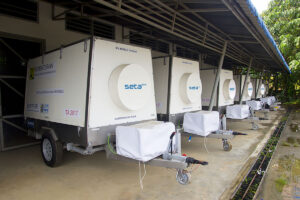
The plant incorporates high-performance equipment mounted on compact self-supporting frames (skids), which reduces civil works, shortens deadlines, and improves the carbon footprint of the deployment. The design includes high-efficiency pumps, state-of-the-art energy recovery systems, and on-demand operation strategies that limit specific consumption (kWh/m³). The modularity allows adjusting the flow to seasonality without energy penalties, maintaining the load factor in optimal ranges.
3) Reduction of chemicals and cleaner pretreatments.
To minimize the use of chemicals, the project favors low-dose physicochemical pretreatments, optimized filtration, and the use of latest-generation reverse osmosis membranes that operate with lower antiscalant needs.
4) Environmental monitoring and governance.
The facility operates with an advanced SCADA that integrates environmental performance indicators (discharge salinity and temperature, specific consumption, chemical dosing, permeate quality, etc.). With this information, the operations team can fine-tune the energy setpoint in real time.

Consortium “turnkey” scope: more than a plant
The contract is conceived as an integral project, covering all the necessary stages to deliver a complete and operational solution:
- Engineering and detailed design of the system, pretreatments, intake, discharge, and transfer pipeline.
- Manufacturing, supply, and integration of equipment in self-supporting skids, simplifying transport, assembly, and commissioning.
- Civil and mechanical works associated with buildings, foundations, piping, valves, and accessories, as well as interconnections with the existing network.
- Electrical systems, instrumentation, and control, with automation and SCADA for efficient and safe operation.
- Commissioning and initial operation for one year, including training of local personnel, knowledge transfer, and maintenance plan.
- Logistics and critical spare parts, guaranteeing availability and continuity of service in an island environment.
This scope ensures that the plant not only produces water, but also integrates into the technical and environmental ecosystem of Mauritius, with a value chain that spans from design to responsible operation.

Modularity, speed, and resilience for an island in transformation
The modular design, consisting of four independent lines of 1,000 m³/day, provides operational flexibility, allowing production to adapt to demand and climate variability. By concentrating equipment on skids, the logistics complexity typical of island projects is reduced, execution times are shortened, and civil work requirements are decreased. The connection to the distribution system completes the circle: efficient production, hydraulic integration, and reliable distribution for the population and local economic activity.
The plant will contribute to alleviating water scarcity and strengthening water security against scenarios of climate stress and rainfall variability. In territories where balance with the environment is decisive, opting for clean technologies, efficient operation, and proactive environmental management is, more than a choice, a necessity.

With this award, SETA consolidates its international positioning as a technologist and provider of comprehensive solutions in water treatment and desalination, demonstrating that it is possible to reconcile the need for resources with the protection of high-value ecosystems. This desalination project constitutes a replicable example for island territories and coastal communities facing the double challenge of guaranteeing water and preserving their natural heritage.